When choosing materials for kitchen and vanity cabinets, builders and contractors usually concern about which type of panel is the right choice for their projects. In our past cases, the most perplexing issue for our clients is when and where to use MDF and plywood.
MDF vs Plywood for cabinets is one of the most important decisions contractors and brands must take when balancing strength, durability, and cost. The right choice impacts not only the appearance of cabinets but also the functionality under daily use and humidity exposure. Today, we will break down their differences, benefits, and sourcing insights to help you with your decisions.
1. Understanding MDF & Plywood for Cabinets
When evaluating MDF and Plywood for cabinets, it’s essential to understand their composition but also their how their appearance, strength, and performance align with you project goals. Both materials offer unique benefits under different cabinet designs, manufacturing precisions, and long-term values.
1.1 What is MDF?
MDF (Medium Density Fiberboard) is made by compressing wood fibers and resin under high pressure to form dense, uniform sheets. In the debate of MDF vs Plywood for cabinets appearance, MDF is usually preferred for its perfect smooth surface – ideal for painted doors, panels, and decorative fronts.
Key Characteristic:
- Smooth, uniform surface: Enables seamless painted or lacquered finishes without visible grain patterns.
- Dimensional stability: Less prone to warping or cracking, ensuring consistent joinery alignment.
- Cost-efficiency: More affordable than plywood or solid wood, making it a smart choice for large-scale, budget-focused projects.
However, MDF is heavier than plywood and more sensitive to moisture. Unless is properly sealed or treated, it can swell in humid areas — a factor that contractors must account for when designing kitchens near sinks or in coastal environments.
1.2 What is Plywood?
Plywood is engineered from multiple layers of real wood veneers, bonded under heat and pressure with alternating grain directions. This cross-laminated structure gives it excellent strength, rigidity, and resistance to moisture – key advantages in the MDF vs Plywood for Kitchen Cabinets discussion.
Key Characteristic:
- High structural integrity: Suitable for heavy countertops and large cabinet systems.
- Natural aesthetic: Retains authentic wood grain, offering a warmer, more organic look.
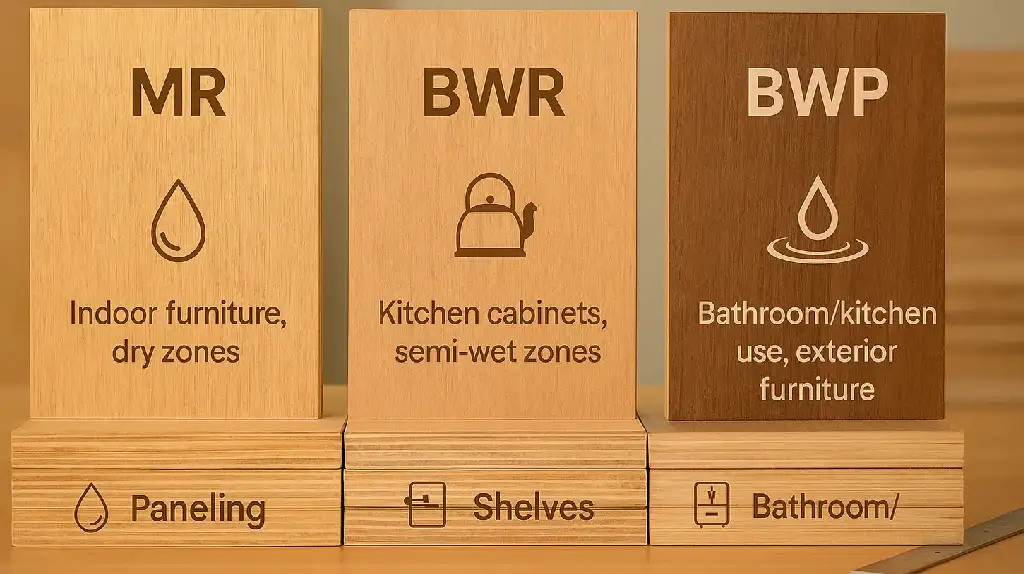
- Moisture resistance: Available in MR (moisture-resistant) or BWP (boiling waterproof) grades, ideal for high-humidity kitchens.
- Lightweight yet durable: Easier handling and installation compared to MDF, reducing transportation and assembly time.
1.3 Quick Comparison
| Aspect | MDF | Plywood |
| Basic Material | Wood fibers + resin compressed into a dense, uniform panel | Layers (plies) of wood veneer glued with cross-grain structure |
| Strength & Load Capacity | Weaker than plywood; can sag on long, unsupported shelves | Stronger, higher load-bearing; better for heavy items and large spans |
| Screw-Holding Power | Fair-poor in edges; pre-drilling recommended; can strip if over-tightened | Excellent; screws grip well in edges and faces |
| Moisture Resistance | Sensitive to moisture; swells and loses strength if water penetrates | Better resistance than MDF (especially with proper sealing / MR grades) |
| Surface Smoothness | Very smooth and uniform; excellent for painting and laminated finishes | Natural wood grain; needs more sanding for ultra-smooth paint finishes |
| Edge Treatment | Edges are porous; must be sealed or edge-banded to avoid fuzzing and chipping | Exposed edges show veneer layers; usually need edge banding for a clean look |
| Weight | Heavier and denser; makes large doors/boards heavier to handle | Lighter than MDF (for same thickness) |
| Cost | Generally cheaper than plywood | Generally more expensive than MDF |
| Common Uses in Cabinets | Door panels, decorative parts, painted fronts, budget cabinet carcasses | Carcass (box), shelves, structural parts, high-end interiors |
| Durability & Lifespan | Adequate for moderate use; less durable in harsh or humid environments | More durable, better for frequent use and heavy-duty projects |
| Best Finish Types | Lacquer, PVC, Melamine, PET | Veneer, PET, Melamine, Lacquer |
| Environmental Considerations | Can be made from recycled fibers; check emission grade (E0/E1, CARB, etc.) | Uses more wood veneer; can be low-formaldehyde depending on glue grade |
| Where It’s Usually Preferred | Shaker/panel doors, painted fronts, decorative elements, cost-sensitive projects | Kitchen base units, wardrobe carcasses, shelves, areas with higher humidity or load |
Quick takeaway for builders and contractors:
Plywood = better strength, screw-holding, moisture resistance, and long-term durability → ideal for cabinet boxes and shelves, especially in kitchens and wardrobes.
MDF = better smoothness and paint quality and more cost-effective → ideal for painted doors, panels, and decorative fronts.
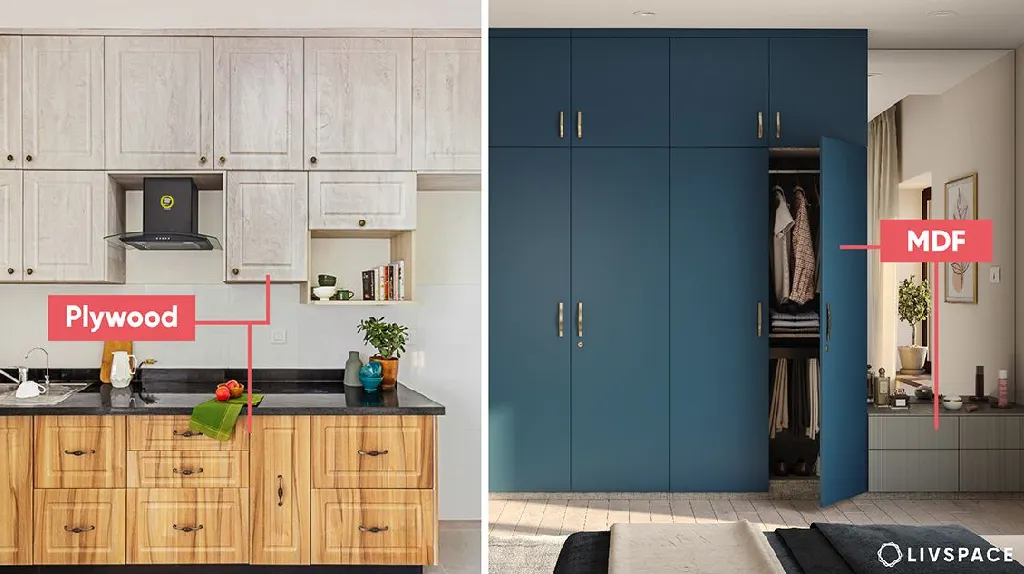
When comparing MDF vs Plywood for Cabinets, MDF excels in achieving sleek, painted aesthetics at a lower cost, while plywood outperforms in structural durability and moisture control. For manufacturers and contractors, a hybrid approach – using plywood for cabinet boxes and MDF for doors – often delivers the perfect balance of appearance, performance, and value.
2. Limitations of Plywood Cabinets (and Solutions)
When comparing MDF vs Plywood for Cabinets appearance, it’s important to understand that while plywood excels in strength and durability, it also presents a few challenges – especially in achieving consistent surface finishes and managing material costs. Recognizing these limitations and applying the right solutions helps contractors maintain both performance and visual appeal in every kitchen project.
Cost Variation Based on Grade
- Limitation: The cost of plywood fluctuates significantly based on its core type, veneer grade, and adhesive quality. High-end options like BWP or hardwood-faced plywood can cost 20-40% more than MDF, which may affect large-scale project budgets.
- Solution: Use premium plywood only in visible cabinet areas (such as doors or end panels) and standard-grade plywood for interior carcasses. This approach optimizes cost while preserving a high-end appearance finish.
Surface Imperfections Require Finishing
- Limitation: As a natural material, plywood can display small knots, slight color differences, or uneven grain textures – traits that may appear inconsistent compared to MDF’s perfectly smooth surface.
- Solution: Apply melamine, natural veneers, or high-quality paint finishes to unify tone and texture. This not only enhances cabinets appearance but also improves surface protection and scratch resistance.
Limited Finish Compatibility
- Limitation: High-gloss acrylic and ultra-matte finishes tend to adhere better to MDF than plywood, posing challenges for modern kitchen aesthetics.
- Solution: Choose specialized PET, lacquers, or engineered veneers designed for plywood substrates. These materials replicate the glossy or matte look of MDF cabinets while maintaining plywood’s structural benefits.
3. Limitations of MDF Cabinets (and Solutions)
When comparing MDF vs Plywood for cabinets appearance, MDF stands out for its ultra-smooth surface and excellent paintability. However, it also has a few practical limitations, especially in terms of moisture resistance, edge durability, and load-bearing capacity. Understanding these challenges and applying the right solutions allows contractors to enjoy MDF’s aesthetic advantages without compromising long-term performance.
Moisture Sensitivity and Swelling
- Limitation: Standard MDF is more vulnerable to moisture than plywood. If exposed to water leaks, high humidity, or poor sealing, MDF panels and edges can swell, deform, or lose strength over time.
- Solution: Use moisture-resistant (MR) or green-core MDF in kitchens, bathrooms, and laundry areas. Seal all cut edges with primer, paint, or edge banding, and avoid direct contact with wet floors or walls by using proper plinths and backing panels.
Edge Durability and Screw Holding
- Limitation: MDF has weaker screw-holding power at the edges compared to plywood. Over-tightening screws or frequent reassembly can cause edge crumbling or loosening, especially on hinges and drawer runners.
- Solution: Pre-drill all screw holes, use appropriate hardware designed for MDF, and reinforce high-stress areas (such as hinge zones) with inserts or hardwood blocks. Where possible, use plywood for carcass structures and reserve MDF for doors and decorative fronts.
Heavy Weight in Large Panels
- Limitation: MDF is denser and heavier than plywood, which makes large doors, tall panels, and thick shelves harder to handle and can increase stress on hinges and fittings.
- Solution: Optimize panel thickness and size in the design stage, use high-quality hinges and lift systems rated for heavier doors, and consider lightweight core solutions or a plywood carcass paired with MDF fronts for easier installation and long-term stability.
Limited to Opaque Finishes
- Limitation: Unlike plywood, MDF does not have a natural wood grain, so it is not suitable for clear coats or traditional wood stains. This can limit design options for clients who prefer a natural timber look.
- Solution: Use MDF where painted, PET, PVC, or laminated finishes are specified, and pair it with plywood or veneered panels in areas where a real wood appearance is required. This allows designers to combine modern smooth finishes with warm, natural elements in the same project.
4. Conclusion
When comparing MDF vs Plywood for cabinets, the choice ultimately depends on your project’s priorities:
- Choose MDF for smooth, painted surfaces and budget-conscious builds.
- Choose Plywood for structural strength, moisture resistance, and long-term ROI.
For bulk manufacturing and OEM sourcing, plywood remains the superior choice — balancing durability, design versatility, and environmental compliance.
By partnering with certified manufacturers like EHUACabinetry, contractors and builds can achieve high-grade precision at competitive costs – ensuring every cabinet built today stands the test of time tomorrow.